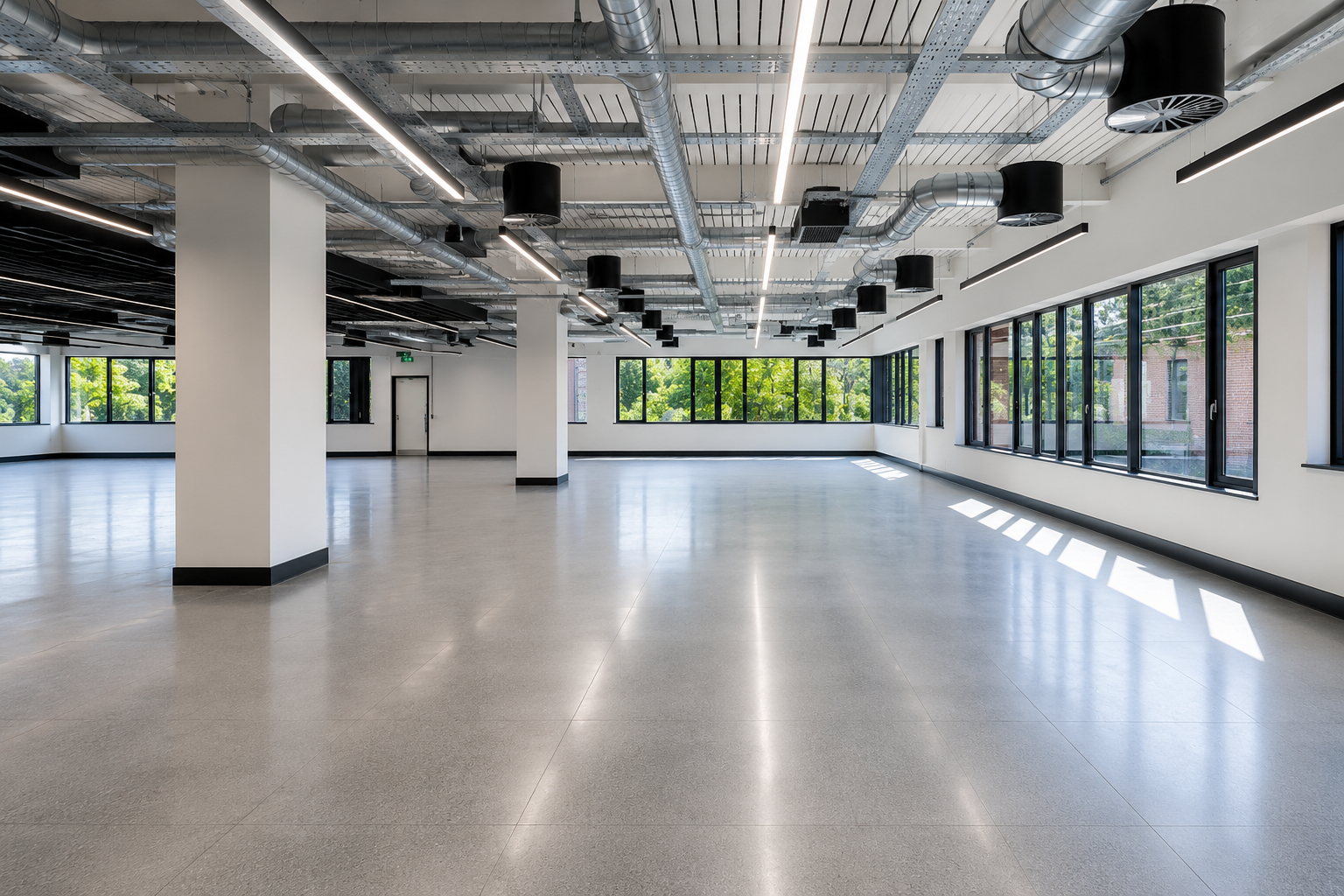

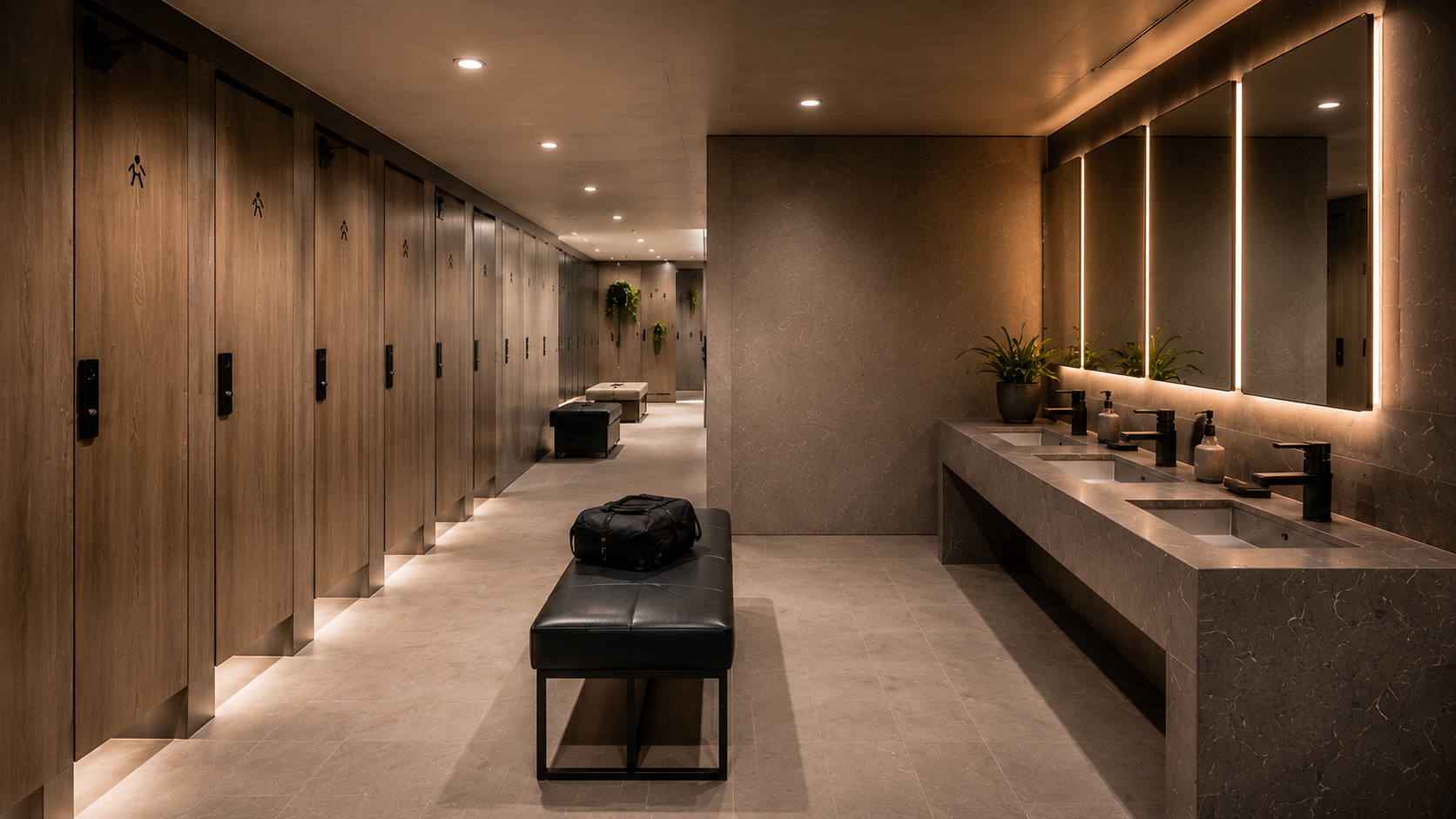
An end of trip facility refurbishment upgrades the showers, change rooms, lockers, and bike storage within a commercial building to meet current tenant expectations, National Construction Code requirements, and green building certification standards. In Sydney's competitive commercial leasing market, end of trip facilities have moved from optional amenity to a core factor in attracting and retaining tenants — particularly as cycling to work and active transport continue to grow across the CBD, North Sydney, Parramatta, and surrounding precincts.
Gladison Constructions delivers end of trip facility refurbishments for commercial building owners and property managers across New South Wales, from scoping and design coordination through to construction and practical completion.
- End of trip (EOT) facilities include showers, change rooms, lockers, and secure bicycle parking provided for building occupants.
- The National Construction Code (NCC) 2022 mandates EOT facilities in new Class 5, 6, 7, 8, and 9 buildings above specific floor area thresholds.
- Existing buildings are not automatically required to retrofit EOT facilities, but Green Star and NABERS ratings reward buildings that do.
- A typical Sydney CBD EOT refurbishment costs between $3,500 and $8,000 per shower/change bay, depending on existing services and finish specification.
- Refurbishments commonly take four to ten weeks from design sign-off to practical completion, depending on floor area and building access.
- Early engagement with a contractor for scope definition avoids the most common cost blowout: discovering unknown services behind walls.
What Is an End of Trip Facility?
An end of trip facility is a building amenity that supports occupants who commute by bicycle, running, or other active transport — providing the infrastructure to arrive at work sweaty and leave presentable. A complete EOT facility includes secure bicycle parking, showers and wet areas, change rooms with bench seating and hooks, and lockers or secure storage for helmets, gear, and personal belongings.
Higher-spec EOT facilities also include drying rooms for wet weather gear, phone charging points, maintenance stations for minor bike repairs, and towel hire services. The Green Building Council of Australia's Green Star rating system awards points for EOT provision at different levels of quality — from basic (showers and lockers) to exemplary (full cyclist amenity with active travel support services). Property Council of Australia research shows that buildings with high-quality EOT facilities report measurably higher cyclist mode share among occupants than buildings where EOT is minimal or poorly maintained.
Why Do Commercial Buildings Refurbish End of Trip Facilities?
Buildings refurbish EOT facilities for one of four reasons: NCC compliance on a change of use or major renovation trigger, Green Star or NABERS certification, tenant retention pressure, or simply because existing facilities are worn, dated, and no longer competitive.
The NCC 2022 introduced mandatory EOT requirements for new Class 5 office buildings above 1,000 m² of net lettable area. Tenant pressure is often the more immediate commercial driver. As of 2026, tenant briefs for Sydney CBD and North Sydney offices increasingly specify minimum EOT standards — including shower-to-desk ratios, individual lockable storage, and separate male/female or gender-neutral facilities. A well-executed EOT refurbishment typically costs less than one month of foregone rent on a vacant floor.
What Does an End of Trip Facility Refurbishment Involve?
An EOT refurbishment scope varies significantly depending on whether the building is starting from a shell, upgrading ageing wet areas, or reconfiguring an existing facility to meet new standards.
| Refurbishment Level | Typical Scope | Relative Cost |
|---|---|---|
| Cosmetic upgrade | Retiling, fixture replacement, new lockers, improved lighting | Low |
| Partial refurbishment | New shower enclosures, replumbing, mechanical exhaust upgrade, locker rooms rebuilt | Medium |
| Full facility refurbishment | Full demolition, new layout, waterproofing, all new services, bike storage upgrade | High |
| New facility fit-out | Construction of EOT from base building shell, all services and finishes | Highest |
A full refurbishment typically involves demolition and strip-out of existing wet areas; AS 3740-compliant waterproofing; ceramic or porcelain tiling; new plumbing including shower heads, tapware, floor wastes, and hot water connection; mechanical ventilation to AS 1668 exhaust requirements; electrical including new lighting, GPOs, and data for charging; locker installation, bench seating, and vanity joinery; and bicycle storage infrastructure. Design coordination is required before construction commences — engaging a hydraulic consultant and mechanical engineer at the design stage is the single most effective cost control measure on EOT projects.
How Much Does an End of Trip Facility Refurbishment Cost in Sydney?
End of trip facility refurbishment costs in Sydney vary based on existing condition, specification level, floor location, and building access. The following cost ranges reflect 2026 Sydney market rates.
| Scope | Cost Per Shower Bay | Notes |
|---|---|---|
| Cosmetic upgrade | $1,500 – $3,000 | Fixtures, tiles, lockers only |
| Partial refurbishment | $3,500 – $6,000 | Replumbing, new enclosures, mechanical |
| Full refurbishment | $6,000 – $10,000 | Full demolition and rebuild per bay |
| New facility fit-out | $10,000 – $18,000+ | Shell to complete, all services |
These per-bay figures cover direct construction costs. Separate cost items include hydraulic and mechanical consultant fees (typically $3,000–$8,000), building permit costs (where required), and project management. Locker costs sit outside the per-bay rate and range from $350 per unit for powder-coated steel lockers to $900+ for full-height stainless steel or laminate lockers with electronic locking. Cost overruns on EOT projects most commonly arise from asbestos found in existing wet area materials in pre-1990 buildings, unanticipated hydraulic rerouting, and structural constraints preventing bicycle storage installation at the intended location.
What Are the NCC Requirements for End of Trip Facilities?
The National Construction Code 2022 requires end of trip facilities in new Class 5 (office), Class 6 (retail), Class 8 (industrial/laboratory), and Class 9 buildings above defined area thresholds. For Class 5 buildings, the trigger is 1,000 m² of net lettable area. The NCC specifies minimum shower numbers, bicycle parking ratios, and change facility requirements calculated on occupant load.
Under NCC 2022 Volume One, Section F, Specification 43, the key ratios are: one shower per 10 bicycle spaces (with a minimum of one for each gender or one gender-neutral facility); and bicycle spaces calculated at one space per 100 m² of NLA for the first 1,000 m², then one per 200 m² thereafter. The Green Building Council of Australia's Green Star Buildings rating tool awards up to three credits under the Wellbeing category for EOT facilities that exceed NCC minimums.
What Questions Should You Ask Before Engaging a Contractor?
Ask potential contractors whether they will coordinate hydraulic and mechanical consultants or whether those appointments are separate. On small-to-mid-size EOT projects, having a single contractor manage all consultants avoids coordination gaps and keeps accountability clear.
Confirm whether the contractor has experience working in occupied commercial buildings — EOT refurbishments in tenanted buildings must manage dust, noise, water isolation, and temporary facility arrangements so that building occupants retain access to functional amenities during works. Ask specifically about the contractor's experience with asbestos management in wet area refurbishments, and request a fixed-price contract with a clearly defined provisional sum or contingency for concealed conditions.
Frequently Asked Questions
Q: How long does an end of trip facility refurbishment take in Sydney?
A: A typical EOT refurbishment in a Sydney commercial building takes four to ten weeks from design sign-off to practical completion. A cosmetic upgrade to an existing facility may complete in two to three weeks. A full rebuild of a large EOT complex in a tenanted building takes eight to twelve weeks. The design and approvals phase adds two to six weeks prior to construction commencement.
Q: Do existing Sydney commercial buildings have to upgrade their end of trip facilities?
A: Existing buildings are not automatically required to upgrade EOT facilities under the NCC unless they are undergoing a building permit-triggering alteration or change of use. However, buildings seeking Green Star certification, or those facing tenant demands for minimum EOT standards, are commercially incentivised to upgrade. Many owners choose to refurbish ahead of a lease renewal negotiation to retain or attract tenants who specify EOT quality in their briefs.
Q: What is a good shower-to-occupant ratio for a Sydney office building?
A: The NCC 2022 minimum is one shower per 10 bicycle spaces, based on calculated occupant load. In practice, Sydney CBD buildings targeting a Green Star rating or premium tenant profile typically provide one shower bay per 30–50 regular building occupants.
Q: Is waterproofing required in an end of trip facility refurbishment?
A: Yes. Any EOT refurbishment involving wet areas must include waterproofing compliant with AS 3740 (Waterproofing of Domestic Wet Areas). In a refurbishment, existing waterproofing membranes are typically removed and replaced because their condition cannot be verified and they are unlikely to meet current standards after years of use.
Q: How much does it cost to add bicycle storage to a Sydney commercial building?
A: Adding bicycle storage to a Sydney commercial building costs between $200 and $800 per bicycle space, depending on the storage type. Wall-mounted horizontal racks are the lowest cost option at $100–$200 per space. Two-tier vertical racks are the most space-efficient at $300–$500 per space. Enclosed individual bicycle lockers range from $800 to $1,500 per space.
Q: Can end of trip facilities be built in a basement car park?
A: Yes. Basement car parks are among the most common locations for EOT facilities in Sydney commercial buildings. Construction in a basement requires attention to waterproofing against groundwater, mechanical ventilation design, and lighting standards for change facilities. Structural penetrations for plumbing must be assessed by a structural engineer.
Q: Who is responsible for end of trip facilities — the building owner or the tenant?
A: End of trip facilities are a base building amenity and are the responsibility of the building owner or landlord. Maintenance, refurbishment, and compliance are the landlord's obligation. In some leasing arrangements, a tenant may elect to fund EOT improvements in exchange for an incentive credit or rent reduction, but ownership and ongoing maintenance of the facility remains with the building owner.
Disclaimer: The figures in this article are general in nature and indicative of 2026 market ranges only. They are not a quote and do not replace a detailed, fixed-price proposal for your specific space and project. Costs vary with scope, building access, site conditions and specification. For an accurate price, request a quote from Gladison.
Written by William Johnstone, Editor at Gladison Constructions. William edits Gladison's Construction Insights, drawing on the team's commercial fitout experience across Sydney and NSW. Last updated: June 2026.